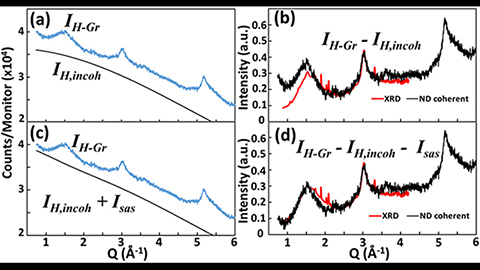
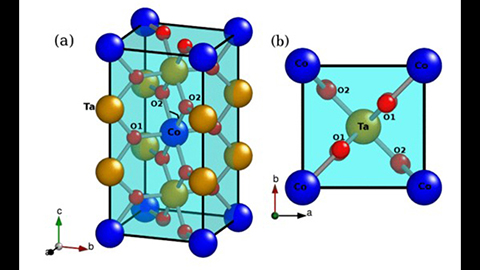
Mission: Neutron powder diffraction aims to elucidate the internal structure of materials whether that is the crystallographic arrangements of atoms, magnetic ordering, or deviations from perfect order.
Instrument Description
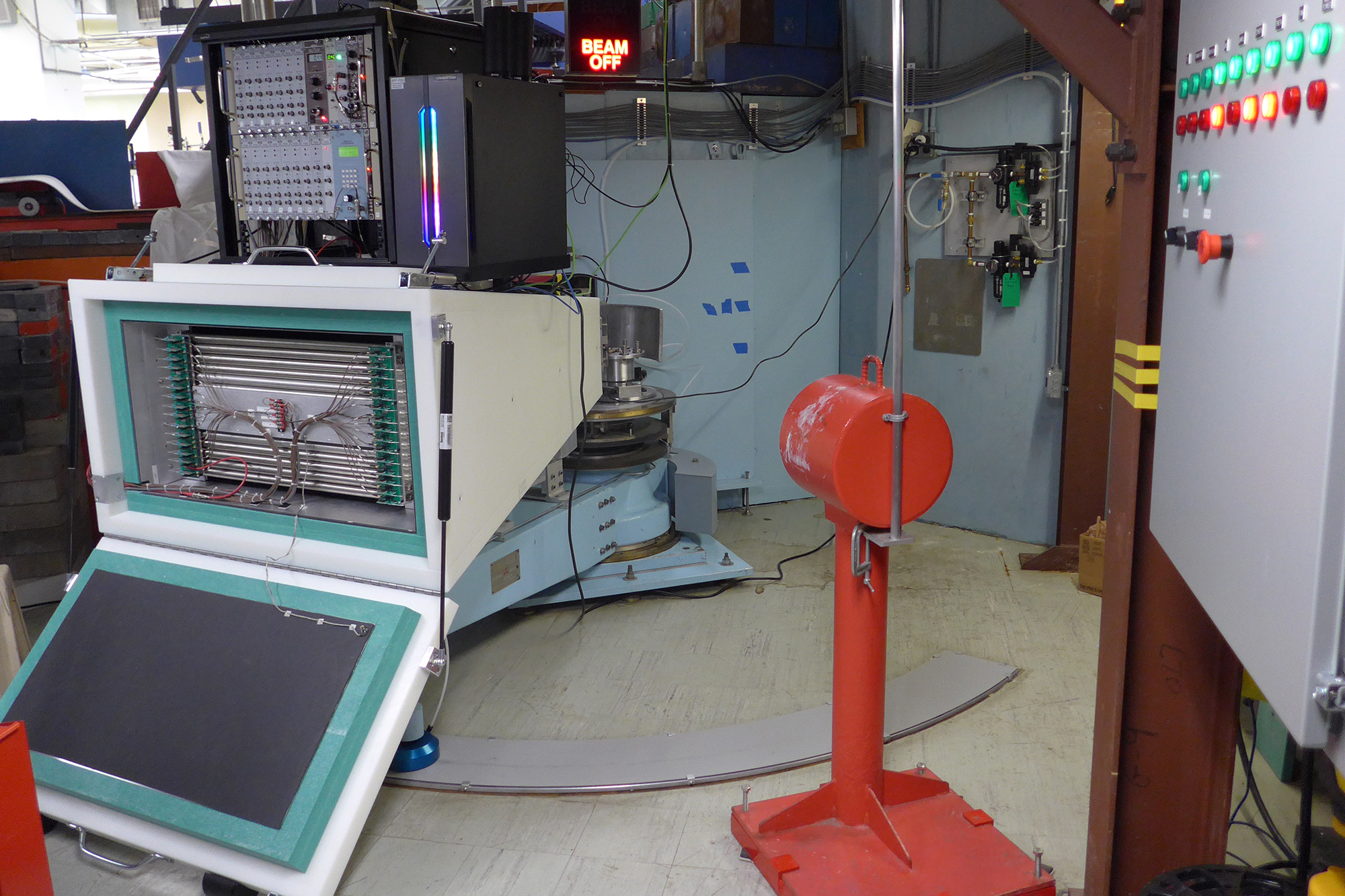
The PSD powder diffractometer is designed to optimize the neutron flux and resolution using a double focusing perfect crystal Si monochromator and a detector bank of 15, vertically stacked linear position sensitive detectors (LPSDs). The monochromator was developed at MURR by Mihai Popovici. It uses the (511) reflection of Si to create a takeoff angle of nearly 90° and a mosaic spread of about 2 arcmins. With this arrangement, no Soller-slit collimators before or after the sample are required. The beam is focused in both the vertical and horizontal directions by arranging the 9 Fankuchen cut Si (511) blades along a vertically curved frame and by applying a bending strain in the horizontal direction. The oscillating radial collimator limits the background neutrons coming from outside the scattering volume. The LPSDs cover an angular range of 20° and a complete diffraction pattern of 100° is obtained by stepping the detector bank through five positions. The instrument wavelength is λ = 1.482 Å, which is very close to the peak of the Maxwell-Boltzmann distribution of our reactor based thermal neutron source. The instrument has been continuously developed with the most recent upgrades being completed in early 2025. It has a long and productive history and has been used for exploring structural and/or magnetic phase transitions, high temperature superconductors, quantum magnets, and multiferroics, just to name a few.
Applications
Researchers utilize neutron diffraction on the PSD in a wide range of topical areas:
- Quantum magnets
- Functional materials
- Ionic materials for next generation batteries
- Engineering materials
- Superconductors
- Hydrogen storage materials
Specifications
- Monochromator: Double focusing bent perfect Fankuchen cut Si (511) crystal (λ=1.485 Å)
- Detectors: 5 linear position sensitive 3He tubes, 24″ sensitive length, covering 20° per detector position
- Collimation: Oscillating radial collimator
- Resolution: 1.5 x 10⁻³ (Δd/d)
- 2θ range: typically 5° to 105°
- Sample environment: variable temperature from 5K to 800K