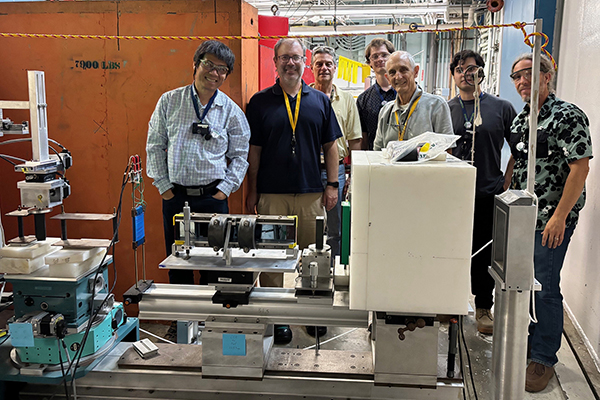
Mission: Neutron reflectometry utilizes neutrons scattered at grazing angles to probe the nuclear and magnetic structures at surfaces and interfaces of thin films, spanning length scales from 1 nm to 150 nm.
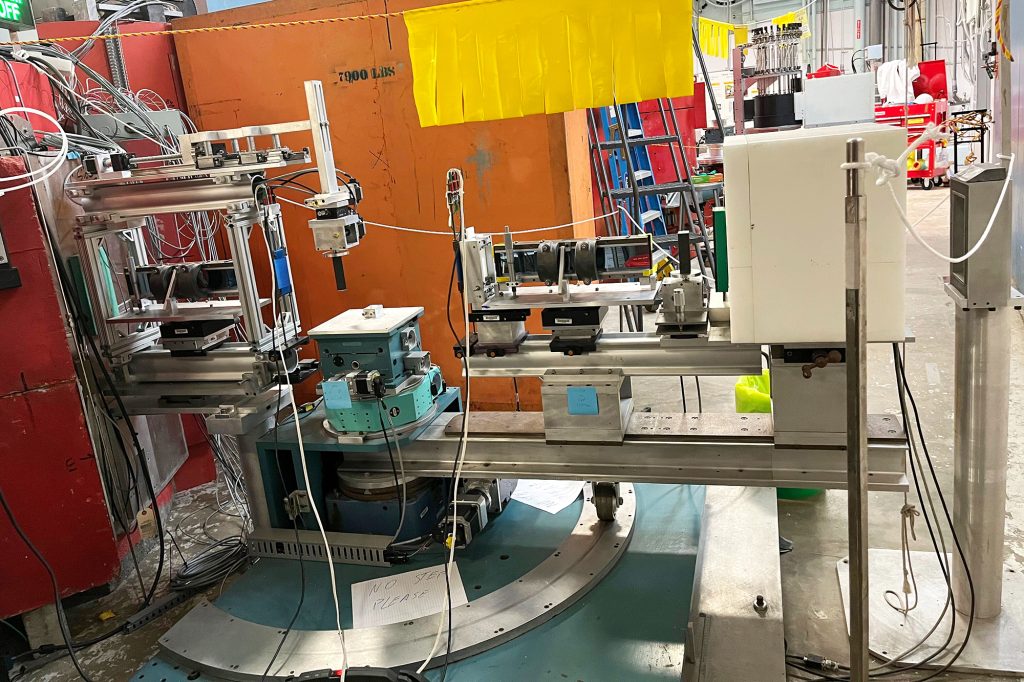
Instrument Description
The GANS neutron reflectometer is the only instrument of its kind at a U.S. university campus. This instrument enables the study of materials in surface and interfacial science, including magnetic multilayers, polymer films, and artificial biological membranes. Primarily used for specular neutron reflectometry, it provides insights into the depth profiles of nuclear composition and vector magnetization in thin films. For magnetic samples, spin-polarized neutron beams enable the distinction between magnetic and structural scattering. For non-magnetic samples on ferromagnetic layers, switching the spin state enhances sensitivity to compositional profiles. Sample size and flatness are limited to approximately 1 × 1 cm² and require atomically smooth substrates, such as silicon, quartz, or sapphire. A common choice is a 76.2 mm (3 in) diameter, 5 mm thick silicon wafer. The GANS supports various sample environments, including temperature-controlled liquid/solid cells, electrochemical cells, cryostats, and electromagnets with beam polarization. For specialized setups, users should consult instrument scientists. Additionally, on-site X-ray reflectometry is available for further sample characterization.
Applications
Researchers are using the GANS to study a broad range of systems at equilibrium states, including these scientific fields:
- Model biological membranes and their intermolecular interaction
- Protein adsorption
- Interfacial structure in drug delivery systems
- Phase separation in polymer films
- Nuclei – magnetic structural relationship under various environmental conditions, including magnetic and electric fields, temperature, pressure, stress, and light
Specifications
- Source-to-Sample Distance: 1911 mm
- Sample-to-Detector Distance: 914 mm
- Wavelength: 2.355 Å, Δλ/λ = 2.0%
- Possible Dynamic Range: 10-7
- Q-range: 0.002-0.250 Å–1, corresponding to a spatial resolution of 1.2 nm
- Resolvable fringes ΔQ: 0.004 Å-1, corresponding to 150 nm thick samples
Recent and ongoing upgrades:
- Spin polarization setup
- Telescoping slits for front (installed) and back (Jan 2026) ends
- Energy analyzer integrated into newly designed detector box (Dec 2025)
- Microstepping motors for all moving components
- Interactive and user-friendly instrument control software
- Nely constructed electrical housing for controllers, amplifiers, and power supplies
- Flow cells for biological and electrochemical thin film studies