Triple-Axis Spectrometer (TRIAX)

Mission: Determination of dynamics in solids in the meV range and low temperature magnetic ordering in single crystals.
Triple-Axis Spectrometer (TRIAX)

Instrument Description

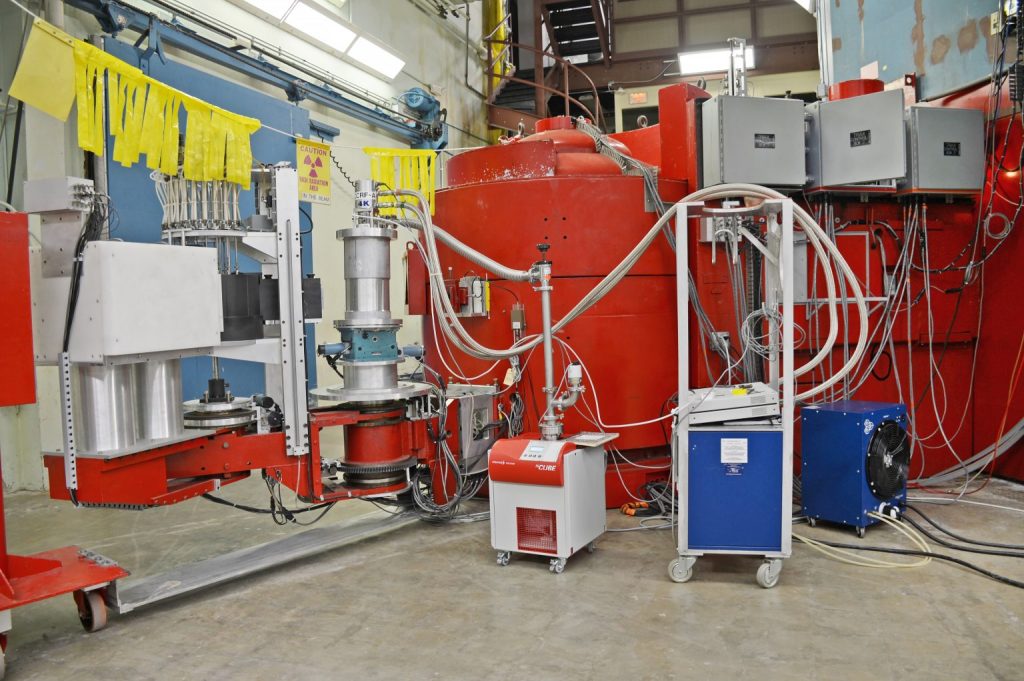
TRIAX is a thermal triple-axis spectrometer and is the only inelastic neutron spectrometer on a university campus in the United States. Triple-axis spectrometers are highly flexible instruments that are designed to study the dynamic response of solids in a typical energy range of ~1 meV up to tens of meV. This enables the study of excitations such as phonons and magnons. TRIAX has also been extensively used for single crystal diffraction — especially of magnetic systems — and for quasielastic studies of magnetic fluctuations. As with any neutron instrument, inelastic studies benefit from larger crystals, but some information can be obtained from powders. Elastic experiments have been performed on TRIAX with crystals smaller than 10 mg and epitaxial thin films.

Applications

Researchers utilize neutron diffraction on TRIAX in a wide range of topical areas:

  • Determination of magnetic structure in single crystal specimens
  • Phonons, magnons, crystal field transitions, magnetic fluctuations
  • Functional materials
  • Frustrated magnets
  • Topological semimetals
  • Multiferroics
  • Quantum critical point materials
  • Quantum spin liquid candidates
  • Superconductors
  • Magnetism in low dimensional systems
  • High entropy oxides and other compounds

Specifications

  • Beam spectrum: Thermal
  • Monochromators: vertically focusing PG (002), Cu (220), and Si (111)
  • Analyzer: flat PG (002)
  • Filtering: PG, Be, Si
  • Scattering angle: up to 120°
  • Software interface: SPICE (LabView based, developed at Oak Ridge National Laboratory)
  • Sample environment: continuous temperature control between 5K and 700K
Collimation
Source-Monochromator:60´43´29´14´
Monochromator-Sample:60´40´20´10´
Sample-Analyzer:80´40´20´10´
Analyzer-Detector:80´40´20´10´

Research Highlights

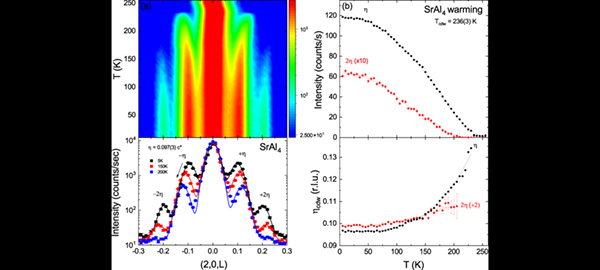
Neutron diffraction along (2,0,L) as a function of temperature for SrAl4.

Tuning incommensurate charge order in Ba1-xSrxAl4 and Ba1-yEuyAl4

Prathum Saraf, Eleanor M. Clements, Danila Sokratov, Shanta Saha, Peter Zavalij, Thomas W. Heitmann, Jeffrey W. Lynn, Camille Bernal-Choban, Dipanjan Chaudhuri, Caitlin S. Kengle, Yue Su, Simon Bettler, Nathan Manning, Peter Abbamonte, Sanada Biswis, Roser Valenti, and Johnpierre Paglione, Physical Review B 112, 035151 (2025).

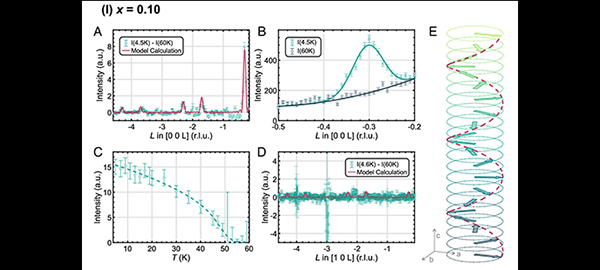
The difference between the neutron diffraction patterns for along (0,0, ) at and 60 K, showing the emergence of magnetic Bragg peaks

Flat-band tuning and emergent itinerant magnetism in Sr(Co1−xPdx)2As2]

Santanu Pakhira, Yongbin Lee, Asish K/. Kundu, Farhan Islam, Zhenhua Ning, Volodomyr Smetana, Anja-Verena Mudring, Thomas Heitmann, Elio Vescovo, Liqin Ke, David Vaknin, and David Johnston, Proceedings of the National Academy of Sciences 122, e2519523122 (2025).

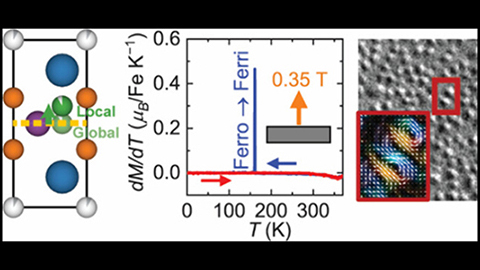
Structural analysis of Fe3GaTe2.

Local Inversion Symmetry Breaking and Thermodynamic Evidence for Ferrimagnetism in Fe3GaTe2

Sang-Eon Lee, Yue Li, Teonkyu Lee, W. Kice Brown, PeiYu Cai, Jinyoung Yun, Chanyoung Lee, Alex Moon, Lingrui Mei, Jaeyong Kim, Yan Xin, Julie A. Borchers, Thomas Heitmann, Matthias Frontzek, William D. Ratcliff, Gregory T. McCandless, Julia Y. Chan, Elton J.G. Santos, Jeehoon Kim, Charudatta M. Phatak, Vadym Kulichenko, and Louis Balicas, ACS Nano 19, 28702 (2025).

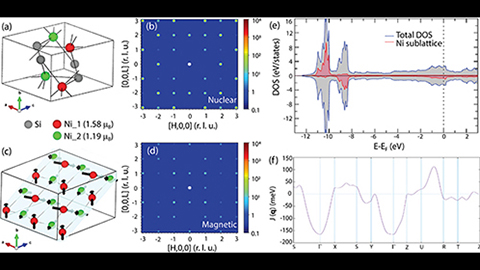
Lattice structure of NiSi and spin correlation between Ni atoms.

NiSi: A New Venue for Antiferromagnetic Spintronics

P. Ghosh, J. Guo, F. Ye, T. Heitmann, S. Kelley, A. Ernst, V. Dugaev, and D.K. Singh, Advanced Materials 35, 2302120 (2023).

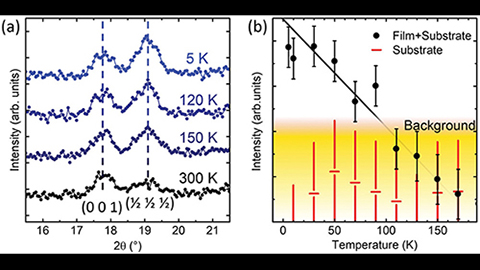
Observation of G-type antiferromagnetic ordering in L5BO bulk and film.

Designing Magnetism in High Entropy Oxides

Alessandro R. Mazza, Elizabeth M. Skoropata Yogesh Sharma, Jason Lapano, Thomas W. Heitmann, Brianna L. Musico, Veerle Keppens, Zheng Gai, John W. Freeland, Timothy R. Charlton, Matthew Brahlek, Adriana Moreo, Elbio Dagotto, and Thomas Z. Ward, Advanced Science 2200391 (2022).

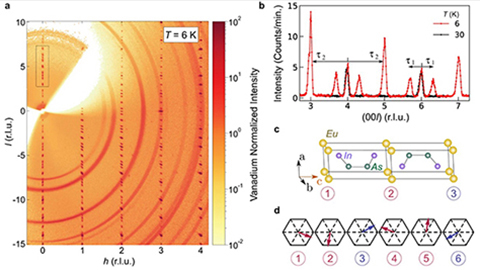
Data for the (h0l) reciprocal-lattice plane measured at a temperature of T = 6 K with the CORELLI spectrometer.

Uncovering Exotic Ordering in Topological Semimetal and Axion Candidate

“Magnetic crystalline-symmetry-protected axion electrodynamics and field-tunable unpinned Dirac cones in EuIn2As2”, S.X. Riberolles, T.V. Trevisan, B. Kuthanazhi, T.W. Heitmann, F. Ye, D.C. Johnston, S.L. Bud’ko, D.H. Ryan, P.C. Canfield, A. Kreyssig, A. Vishwanath, R.J. McQueeney, L.L. Wang, P.P. Orth, and B.G. Ueland, Nature Communications 12, 1 (2021). Doi: 10.1038/s41467-021-21154-y