Mission: Neutron depth profiling utilizes neutron capture reactions to produce isotopic dependent concentration profiles as a function of depth (<50 micrometers) in any uniform substrate.
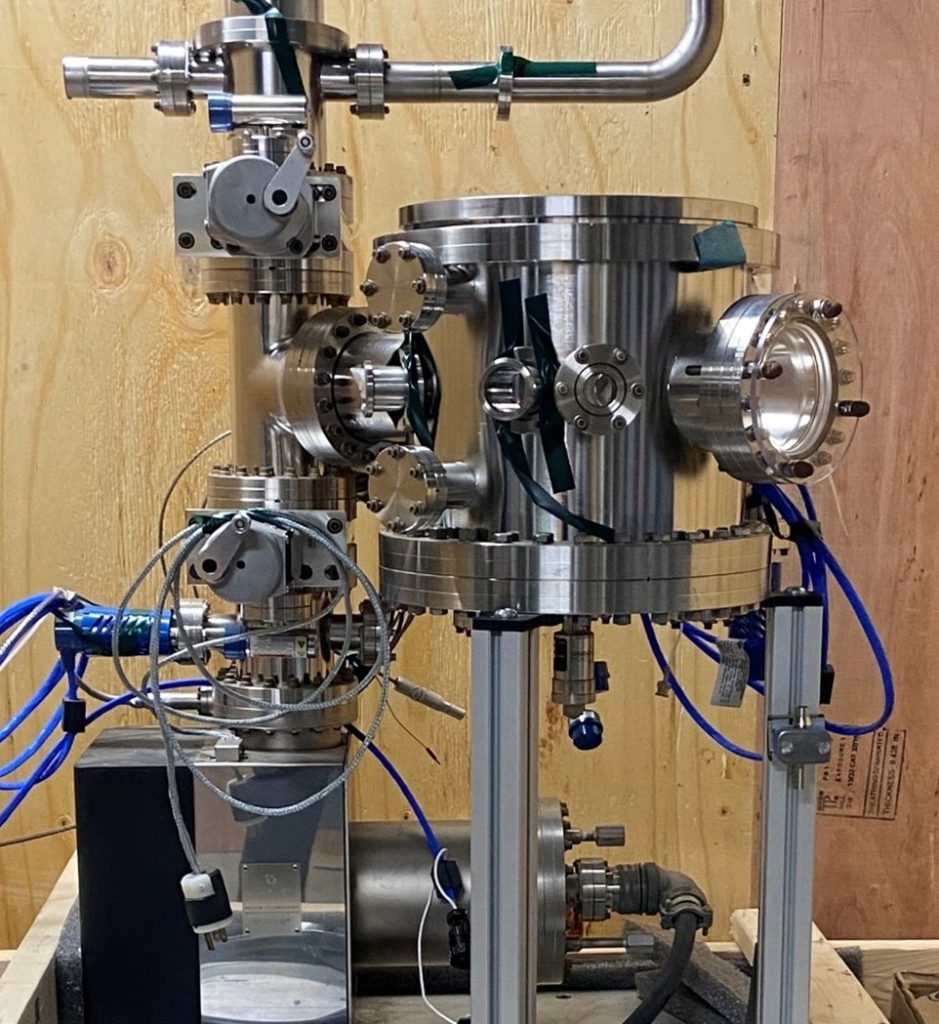
What is NDP?
Neutron Depth Profiling (NDP) is a nondestructive analytical nuclear technique for determining the concentration of certain light elements as a function of depth (< 50 micrometers), usually in situ, in any uniform substrate. NDP is uniquely suited to light nuclides (3He, 6Li, 10B, 14N) with detection limits down to the parts-per-billion range (ppb) depending upon the nuclide, with applications in quality control and calibration, lithium-ion battery research and boron concentrations in silicon, integrated circuits, and glass.
NDP works by illuminating a material with a thermal or sub thermal neutron beam. Specific nuclides inside the sample undergo neutron induced charged particle reactions. These interactions release protons, alpha particles, and recoil atoms which begin to travel outward through the sample and lose energy through interactions with electrons of the sample. The rate of this energy loss is known as the stopping power of the sample. Detectors measure the residual energy of the charged particles or recoil atoms upon exiting the sample and using the stopping power, a depth profile of the nuclide of interest is produced.
Instrument Description
In development, coming soon
Applications
- 3He retention and concentrations in fusion and other materials
- Boron implantation and concentrations in silicon and other materials
- Lithium concentration in biological tissue
- Boron concentrations in biological tissue for Boron Neutron Capture Therapy (BNCT)
- Lithium concentration and mobility in Li-ion batteries, electrodes, and while undergoing charging/discharging
- Lithium based organic light emitting devices (OLEDs)
- Boron and Nitrogen concentrations in thin films and coatings
Specifications
- Non-destructive and Operando Depth Profiling
- Thermal Neutron Flux: ~ 1 x 108 cm2/s
- Probing Depth: < 50 μm (sample dependent)
- Typical Resolution: 10-20 nm (sample dependent)
- Detection of the following stable isotopes: 3He, 6Li, 10B, 14N, 17O, 33S, 35Cl
- Detection limits range from 1 x 10¹² – 1 x 10¹⁶ atoms/cm2 (isotope dependent)
- 4 ConFlat (CF) Flanges for electrical feedthroughs and heating stages (Ex: Li-ion coin-cell: in development)